–By J.S. Porter
for Rachel and Cozzie
Fourteen miles east of Havana is Hemingway’s Cuban home—Finca Vigía, “lookout farm” – now Museo Hemingway. It’s located in the small but growing town of San Francisco de Paula.
Built in 1886 by the Catalan architectural firm Miguel Pascual y Baguer and chosen at first sight by his third wife, Martha Gellhorn, Finca Vigía was purchased by Hemingway in 1940 for a cost of $12,500. Consisting of four hectares, the lookout farm offers you a panoramic view of Havana. You can see the city all the way down to the harbour. Hemingway lived there with his last wife, Mary, for nearly 20 years, the longest time he ever lived in one place.
On the lush green property, Hemingway had a swimming pool, a tennis court, a makeshift baseball diamond, a burial site for dogs, unmarked graves of numerous cats, a guest house, a cockfighting space, animal heads on the walls, and books in every room. He had a tower built in which to write that became a sanctuary for his cats.
Hemingway’s three-storey tower had what seemed to be a perfect space for writing. But was it too distracting, the view too beautiful? Or — had the daily barrel of booze, depression and the nine concussions, including two from airplane crashes, taken their toll on his discipline and concentration in the final years? Whatever the reason, the Tower was not a place where Hemingway wrote; it was a place where his cats played.
His famous boat, Pilar, is also now on the property. Vines and flowering trees and a Ceiba tree at the front entrance, wandering cats, stray dogs sprawled languidly on the front steps, and windows you can open to let life in, make Finca Vigía a light-filled place you’d like to spend your own days. Cheryl and I thought so anyway.
We were particularly moved by the marked grave for Black, his canine companion, but were surprised not to see a similar grave for Boise, his favourite feline companion. About Black, he once said, “I miss Black Dog as much as I miss any friend I ever lost…” While both animals were alive, he had said in an interview, “I do not know what I will do if anything happens to Black Dog or Boise, just go on working I suppose.” Cats were important to Hemingway. They roamed freely in his house and yard. He liked their cunning, their endurance, their combination of fragility and toughness.
How can such a small animal be so fearless? Does the “domestic” cat – cats can’t ever be fully domesticated—still possess an ancestral lion gene? Cats bow to no one, neither man nor beast.
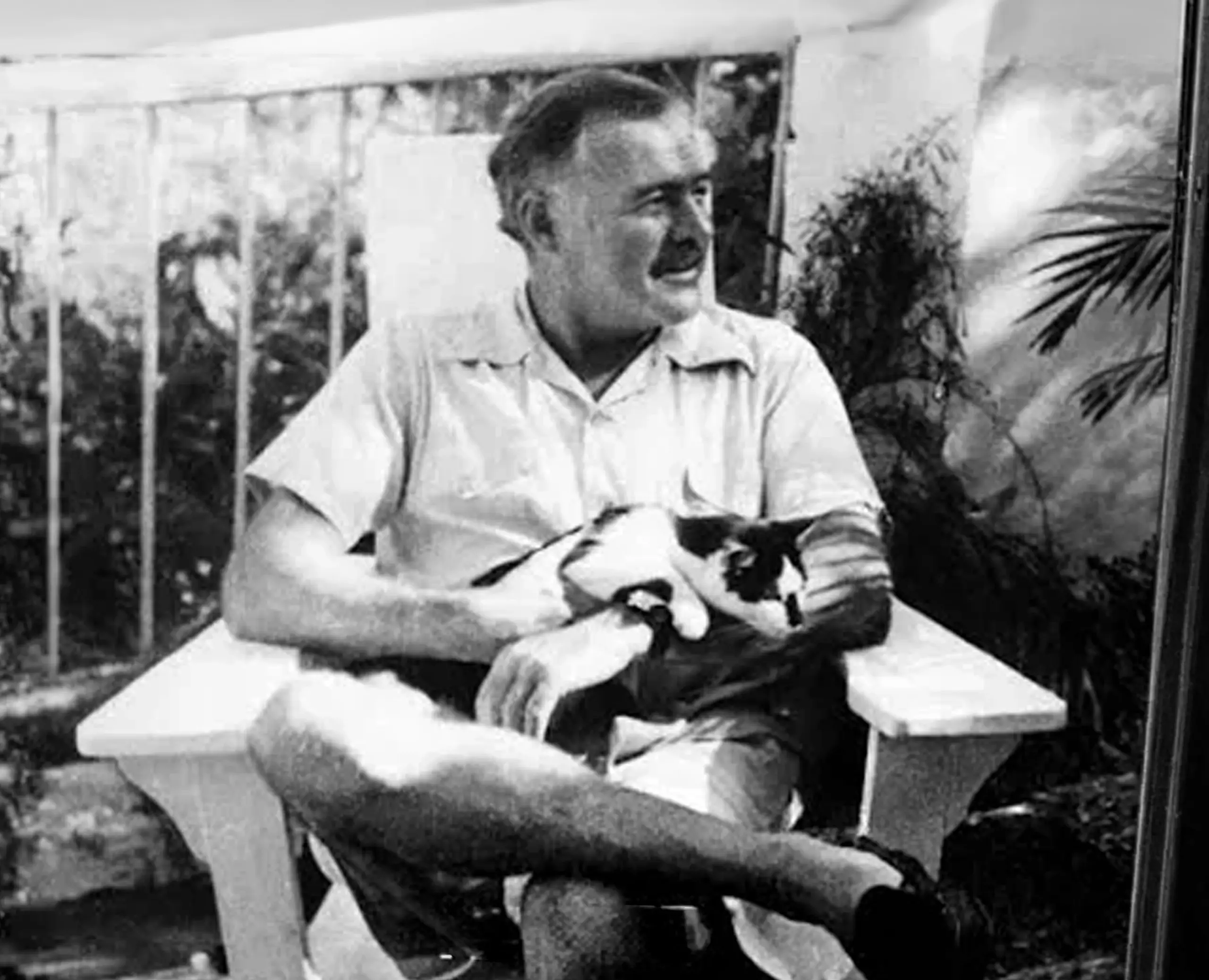
At his Cuban home, Hemingway had so many cats you couldn’t always count them “until you [saw] them all moving like a mass migration at feeding time.” Initially, according to Carlene Fredericka Brennen’s fine book, Hemingway’s Cats, Hemingway had 11 cats, with three house cats—Princessa, Boise, and Willie—a clowder frequently added to by strays and neighbourhood additions. “The cats slept in the guest bedroom and later lived in a room on the second floor of the white tower Papa had built …” They were always close at hand during his times for eating, drinking, conversing and typing his manuscripts. Some of his most tender photographs involve him holding, carrying and stroking them.
Where Hemingway most shows his palpable love for cats inheres in two works of literature: the short story “Cat in the Rain” and his posthumous novel Islands in the Stream. In the novel, Hemingway devotes over 70 pages to cats. The pages of “Cuba,” Part II are overrun with the names and presence of his Cuban cats; they’re major characters in the narrative. His sentences about them braid knowledge with love:
“His cat lay on his chest and he pulled a light blanket over them both…”

“The cat kneaded his chest softly…and he felt the cat’s long, lovingly spread weight and the purring under his fingers.”

“The cat lay, contentedly, breathing in rhythm with the man…”
The purr. A music box. Margaret Atwood in Oryx and Crake compares the frequency of a cat’s purr to “the same frequency as the ultrasound used in bone fractures and skin lesions.” The purr, the novel speculates, has healing power. It’s one of nature’s great sounds—soothing, calming. Kneading is also one of nature’s great ceremonies, Shamanistic in its ritual dance, sometimes performed on the human chest.