–By J.S. Porter
(for Blake)
Shortly after the three-part, six-hour documentary film HEMINGWAY by Ken Burns and Lynn Novick in 2021, a book appeared entitled One True Sentence: Writers & Readers on Hemingway’s Art edited by Mark Cirino & Michael Von Cannon, with an introduction by Burns and Novick. The book took its inspiration from Hemingway’s famous musing in A Moveable Feast:
“All you have to do is write one true sentence. Write the truest sentence that you know.”
In One True Sentence, scores of critics and readers choose the particular sentence in Hemingway’s work that rings truest to them. Brian Turner chooses this one from The Old Man and the Sea: “Then the fish came alive, with his death in him, and rose high out of the water showing all his great length and width and all his power and his beauty.” I find the sentence remarkable as well, especially the fish coming alive “with his death in him.” Andrew Farah chooses this sentence from “Ten Indians: “In the morning, there was a big wind blowing and the waves were running high up on the beach, and he was awake a long time before he remembered that his heart was broken.” The sentence sneaks up on you, and then it plunges a knife.
You don’t need to turn to a recognized master of sentences like Hemingway to write sentences with grace and power. Many years ago, I remember reading a sports article in The Guardian about the Ali-Foreman fight in Zaire when there was fear that Ali might be severely hurt or even killed in the ring. The sentence has remained in my mind for over 50 years. “He [Ali] could pick flowers in a minefield and never miss a bloom.”
I don’t need to turn to Hemingway or a gifted sports writer for a true sentence. I can turn to my grandson Blake. Years ago, when he was about eight, he was sleeping with his cousins Kaizen and Marshall, and they were all talking about love. Who knew that young boys talked of such things? The older boys spoke first, and then Blake. He had just played a game of soldiers earlier, where you try to knock down the opposing team’s plastic soldiers with a marble. He played on a team with his cousin Aion, and this is what he said about love. “I cheered for her, she cheered for me, and I felt love.” To this day, Blake’s “one true sentence” remains the best definition of love that I’ve ever come across.
Some years ago, my friend John Robert Colombo, poet, editor and Canada’s master compiler of quotations, said that he’d like to comb through my published work and select the best sentences he could find for an upcoming book of quotations, likely the last of his compilations.
Colombo’s Canadian Quotations (1974)
Colombo’s Concise Canadian Quotations (1976)
Colombo’s New Canadian Quotations (1987)
The Dictionary of Canadian Quotations (1991)
Colombo’s All-Time Great Canadian Quotations (1994)
Colombo’s Famous Lasting Words (2000)
The Penguin Dictionary of Popular Canadian Quotations (2006)
The Northrop Frye Quote Book (2014). This one is my personal Colombo favourite, judicious selections A to Z showcasing one of Canada’s great sentence-makers. Here’s Frye on Canadian speech: “…where Canadians got the monotone honk that you’re listening to now I don’t know—probably from the Canada goose.” For ten years, Colombo read and culled from the thirty-volume Collected Works, a Herculean task and accomplishment of independent research and scholarship.
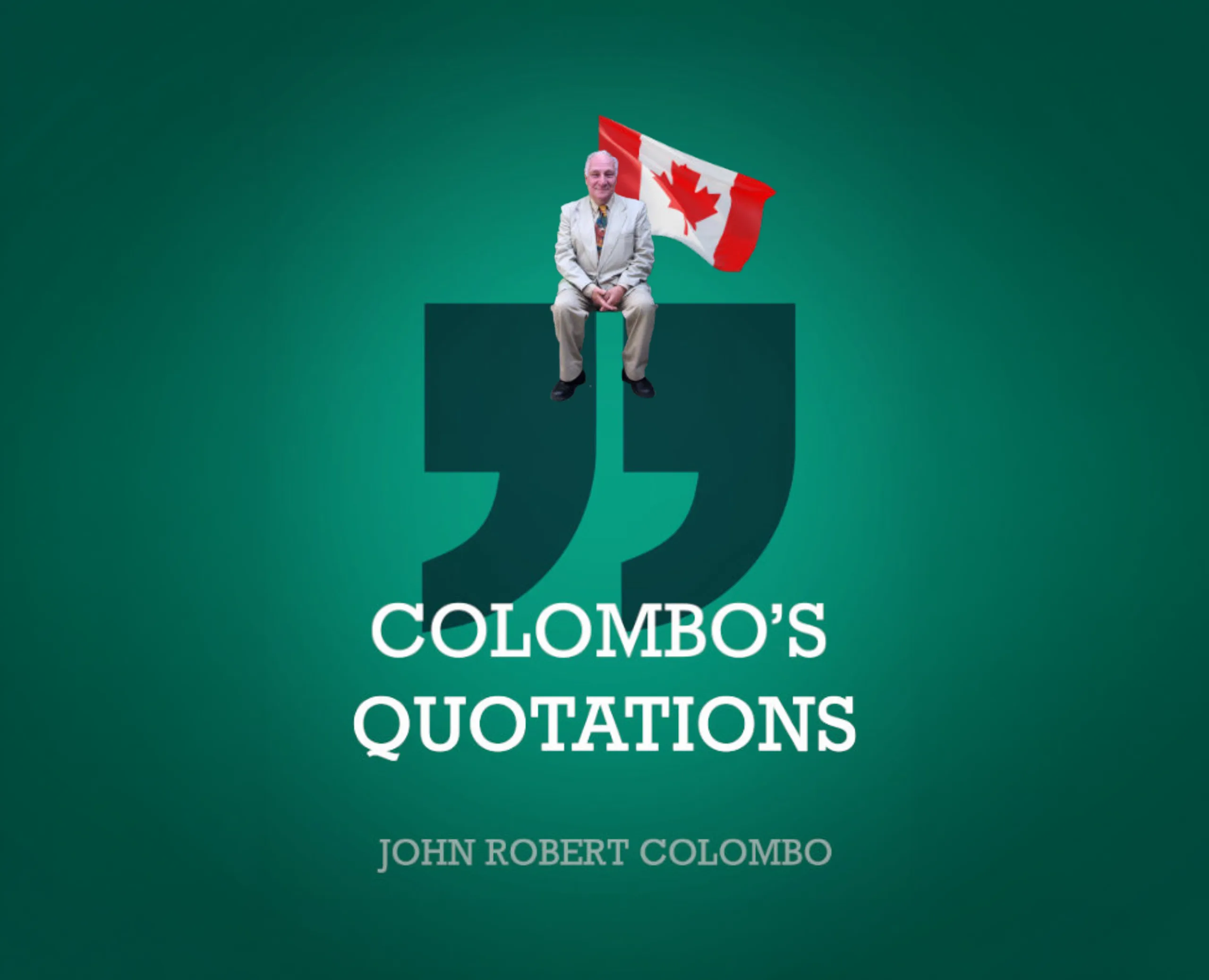
Colombo’s Quotations (2025), quotations by Canadians or about Canada. This 8th and final such collection offers over 6,000 sourced quotations. Page count: 378. DOWNLOAD FOR FREE, COLOMBO.CA. The book teems with “true” sentences. JRC very generously selected some of my truest sentences, among which are these:
Spirituality/Spiritbookword: the breath of the word in the book. I
jumped up and down like a four-year-old. Hallelujah! I had found my
word. I could now look for spiritbookwords in others.*J.S. Porter,
essayist, coining a word to refer to his sense that the spirit
inhabits the script of the word that is bound and unbound in the book,
Spirit Book Word: An Inquiry into Literature and Spirituality (2001).
Books/I like books in the same ways I like dogs. I like the look of
them, the feel of them, the smell of them. My heart quickens when I
see someone reading. I feel most myself when turning and underlining
pages. *J.S. Porter, essayist, Lightness and Soul: Musings on Eight
Jewish Writers (2011).
Books/I come to a book shyly, as I would a temple. I open it as I
would a snake-basket. I’m not sure of the exact nature of the reptile,
but I know it might be dangerous, even lethal. I wait expectantly,
patiently, for the bite. I pray that it may be life-altering.*J.S.
Porter, essayist, Spirit Book Word: An Inquiry into Literature and
Spirituality (2001).
Reading/I remember writers the way some remember love affairs. I
remember the genealogy of my reading the way the Bible remembers who begets whom.*J.S. Porter, essayist, Spirit Book Word: An Inquiry into Literature and Spirituality (2001).
Reading/We readers, aglow in the word, huddle together like penguins
against the world’s chill, its indifference and amnesia…When you read,
you read against the grain of death. You read stubbornly, defiantly.
You read desperately, as if looking for a missing child. You read
deliriously, in the hope of ecstasy and the fear of the inevitable
misreading.*J.S. Porter, essayist, Lightness and Soul: Musings on
Eight Jewish Writers (2011).
Consolation/Certainly, reading offers its practitioners a measure of
consolation. The self, no matter how grand, is small, and life, no
matter how dream-extended, is short. Each of us is confined to one
life in one time. Each of us by book-vessel can appropriate, kidnap
and intersect other selves.*J.S. Porter, essayist, Lightness and Soul:
Musings on Eight Jewish Writers (2011).
Write what you mostly deeply care about. Aside from loved ones, it seems that I most deeply care about reading and books.