–By J.S. Porter
for John Robert Colombo
“ATWOOD, MARGARET
Margaret Atwood, like the CN Tower, is a free-standing structure, and needs no patronizing props of reference to her sex or her nationality.” Quote from Northrop Frye in John Robert Colombo’s The Northrop Frye Quote Book.
No one has put Toronto, city of raccoons and ravines, on the world literary map as securely as Margaret Atwood. To quote myself from a Globe review years ago, “Margaret Atwood is a writer who has scratched her name on the tablet of the English language. She belongs to the world.”
How does one read the CN Tower of Canadian writing, someone who has achieved excellence in fiction, non-fiction and poetry? Has any writer since John Updike been so good at so many things? Does one fall into the Tall Poppy Syndrome and seek ways to cut her to a size more easily manipulated? I hope not. I’d defy anyone to read Book of Lives and not come away awed and thankful for her humour, her playfulness, her intellect, her imagination. She is “someone on whom nothing is lost,” in Henry James’s phrase. There are many different ways to read her.
My daughter, my wife and I read her Cat’s Eye at about the same time, Rachel for her Grade 13 English and Cheryl and me as her reading sidekicks. At last a writer who knows that pre-teen females are not made of sugar and spice and everything nice, I thought to myself. My daughter, I think, read the novel as an aspiring poet—she knew firsthand the sugar and spice crap– mesmerized by the word-wizardry of an elder, and looked up to an older woman’s creativity on the page as a young female hockey player today looks up to the speed and skill of Marie-Philip Poulin on the ice surface.
On Atwood’s book cover, the shhh gesture is the same one that Vladimir Guerrero Jr. makes when he hits a home run for the Blue Jays. Index finger to the lips, an inaudible blowing, he tells fans to keep it a secret. Don’t tell anyone. Has Atwood hit a home run in her new book? Yes. Does she reveal secrets? Yes. And, If not secrets exactly, then loads of surprises, for me at least…
To be a writer, Atwood says you need to draw on the Greek gods: some Apollo, for form and structure, and you need the energy and mischief of Hermes “god of tricks and jokes and messages, concealer and revealer of secrets, patron of travellers and thieves, conductor of souls to the Underworld.” And maybe you need a dash of “Bacchus, god of wine, proponent of divine intoxication, dissolver of inhibitions.” Atwood’s intoxicant of choice is coffee (caffeine).
Margaret Atwood didn’t begin her writing career as Margaret Atwood; she began as Peggy Atwood until “an impresario of poetry on campus” and her first publisher, John Robert Colombo, told her that Peggy was too light a first name to carry the future weight of Atwood’s production. She started to use M.E. Atwood so as not to be tagged as a girl and then finally settled into the clear, crisp and stately, Margaret Atwood.
How did the international sensation The Handmaid’s Tale come to be? Many strands, many influences, no doubt, but one was Northrop Frye. After her taking his Milton course at U of T and graduating with an Honours BA in English with a minor in philosophy, Frye suggests that she go to Harvard for graduate studies. She does so and meets Percy Miller, the author of The New England Mind: The Seventeenth Century. She takes his 17th. century American literature course and begins to see that the movement to make the US into a theocratic state which controls women’s bodies in accordance with a few cherry-picked biblical verses began in the early years of the Republic. She dedicates The Handmaid’s Tale to Percy Miller along with Mary Webster.
One of the joys of wading into the 600 pages of Atwood’s lives is to see her in interspersed black-and-white and colour photographs from baby to young girl to young woman to mature woman to Atwood at her present-day 86 years. The face changes, nature insists on lines and wrinkles for us all, but something remains unchanged. The impishness? The piercing see-through you eyes? The trickster who is always at play? You see her with her parents, both born in Nova Scotia and their parents the same (further back in the family heritage the Atwoods come up from Cape Cod, Massachusetts) with her brother (a neuroscientist) and sister (a dietician and nutritionist like her mother), with her daughter Jess and lifelong partner Graeme Gibson, novelist turned birder who seemed to be as quirky and lively as she is.
You see her canoeing, dressing up, acting silly, meeting the Queen, and, in my favourite photo, sitting at a desk in Berlin typing the manuscript of The Handmaid’s Tale, a dystopian masterpiece that belongs on the same shelf as Huxley’s Brave New World and Orwell’s 1984.
Atwood acknowledges her longtime friendship from summer camp days with painter Charles Pachter whose designs adorn six of her poetry books. In those early days in the 60s she was known as “Peggy Nature,” fitting for a daughter of a horse-loving mother and an entomologist-father who lived many summers in the bush of northern Quebec, often with daughter in tow.
My favourite Pachter image of his friend Atwood appears on the cover of Atwood’s collection of critical prose, Second Words. It’s an acrylic young red-headed Atwood in black sweater, arms folded at the table, with coffee mug, gazing out to the viewer.
Especially stunning are the stunning silkscreen prints in The Journals of Susanna Moodie. In his brief but beautiful memoir accompanying the Atwood poems on an early Canadian pioneer, Pachter writes: “The Journals of Susanna Moodie is nothing if not my homage to the writer, poet, and friend whose genius has been a sustained source of inspiration for my imagination.” How often in Canadian literature, or in any literature of the world, does a talented painter’s images enrich the words of a great writer?
Atwood freely and generously gives thanks to those who have made gestures of support over the years; from page 563 to page 570 she thanks readers, publishers, editors, colleagues, friends, birders and nature lovers in the form of Acknowledgements. That said, she’s a Scorpio. She knows how to sting intruders, snoops, who would pry into personal matters, especially those concerning her daughter.
“Atwood doesn’t forget those who have wronged her (Shirley, Graeme Gibson’s first wife, Jan Wong and Margaret Wente formerly of The Globe and Mail, and bands of ultra-feminists who pilloried her over the Steven Galloway case in which a professor and author was accused of sexually assaulting a student) …” Atwood simply asserted her conviction that someone, male or female, is innocent until proven guilty. Galloway was proven innocent by the court.
Atwood the feminist is also a clear-eyed realist. For her, men and women are not of different species. They’re from a single species with different ways of seeking and exercising control and dominance.
How does a science-based, fact-based person indulge in palm reading and tarot card interpretations? Atwood could answer with Whitman, “I’m vast. I contain multitudes.” Clearly her love of science and her interest in the occult and the esoteric are simply two sides of a many-sided human being.
How does one woo such a complex being? Graeme mastered the art quickly. He bought Atwood a pair of boots, the kind ideal for hiking and canoeing and then he took her on an extended canoe trip in Algonquin Park. To this reader, their relationship seems magical, two mischief-making tricksters playing with each other and others, but there were strong differences at times. Atwood wanted a second child, Gibson didn’t. Atwood gave in, with some lingering bitterness which she turned into funny-bitter Ann Landers letters to the self.
The role of Dennis Lee in her life. He’s “the fifth business,” defined by Robertson Davies as “a character who is neither the hero nor the heroine , nor is he the antagonist. Instead, he’s the one who sets things in motion, often unwittingly.” Dennis Lee’s House of Anansi reprints Atwood’s Circle Game and later publishes Survival with Dennis as editor; he also publishes Graeme Gibson’s Five Legs; she then edits Matt Cohen’s Typing (Cohen describes her as “slight and elfin,” “brusque and friendly”) and works by other Canadian authors for Anansi, with Dennis and sometimes alone, while also serving on the board.
A love story. What comes through to me strongest in the book is the love story between Graeme Gibson and Margaret Atwood, the bond between one woman and one man. Maybe love always dominates anything it’s a part of. Like “Moulin Rouge,” Book of Lives is “a story about a time, a story about a place, a story about the people. But above all things, a story about love.” And in that story if you listen well is a whispered refrain: “The greatest thing you’ll ever learn is just to love and be loved in return.”
In the last several books, (Babes in the Woods, Dearly, the final uncollected poems in Paper Boat) Graeme Gibson is on Atwood’s mind and in her heart. Always tough, Atwood in her post-Gibson utterances allows herself to be vulnerable and the tenderness shines through. The last lines of “Mr. Lionheart” are particularly poignant in their brevity:
Lions don’t know they are lions.
They don’t know how brave they are.
She writes these lines knowing Graeme’s slide into dementia and knowing what he once loved—birds—he no longer remembers the names of.
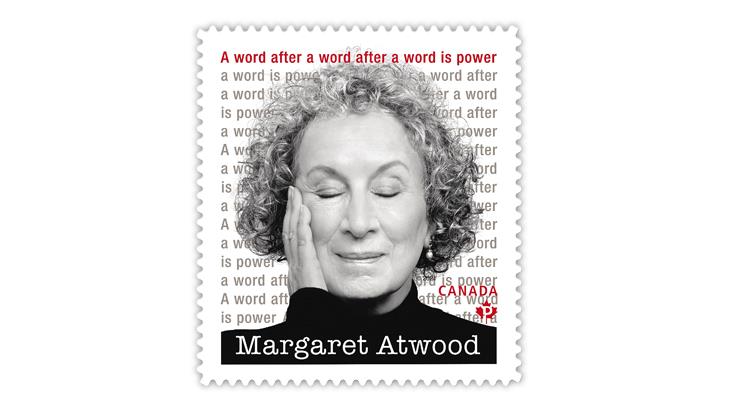
You know you’ve arrived when your university names a pub after one of your novels (Cat’s Eye) or you become a society and a journal or, best of all, when your country puts your image on a stamp with your words, “A word after a word after a word is power.”
A Personal Comment
Something surprising happened to me in the early 2000s. Martin Levin, the Books editor of the Globe and Mail, asked me to review Atwood’s Negotiating with the Dead, subsequently printed as On Writers and Writing with my anonymous words on the back cover. A few years later, he assigned another work of her critical prose to me, Moving Targets. “Moving Targets is a surprise box…you get humour…you get bite…you get lines of perfect pitch and tone.”
I met Atwood once, sometime after my reviews. It was in Toronto, in the Cardinal Newman building where an anniversary of the Literary Review of Canada was taking place. I think the editor at the time, Bronwyn Drainie, introduced us. We shook hands. Atwood stared at me with her x-ray eyes, seemed to find me harmless enough, and said, “Hi.” I replied, “Please to meet you.” Such is the taciturnity when a Nobody meets a Somebody.
Some years later, I went to Mohawk College to hear her and Ian Brown in conversation about her Massey Lectures, Payback: Debt and the Shadow Side of Wealth. I felt the power of her intellect. She held in her hand a single word, debt, and turned it into its history, its many-sidedness and its repercussions. She cracked a few jokes, though none as memorable as the one in Book of Lives: Question: “Are you Margaret Atwood?” Answer: “Not today.”
I continue to read Margaret Atwood, particularly her poetry. First and foremost, for me she is a poet. Her poem “Lucky” in Paper Boat is one of the most beautiful love poems I’ve ever read. I want to read Hag-Seed next, her re-writing of Shakespeare’s The Tempest from play to novel.